Projects / Housing and Public Buildings
Rapid Building Safety Assessment (RBSA)
- Client / financing
- Norwegian Refugee Council (NRC)
- Location
- Palestine
- Dates
- 2026
CEP was commissioned by the Norwegian Refugee Council (NRC) to undertake a comprehensive Risk-Based Structural Assessment (RBSA) of conflict-affected buildings across the Gaza Strip, with the objective of evaluating structural safety, identifying risks, and informing prioritized rehabilitation and recovery interventions. The assignment formed part of NRC’s broader shelter and infrastructure response program, aiming to support safe re-occupancy and guide evidence-based decision-making under highly constrained and volatile conditions.
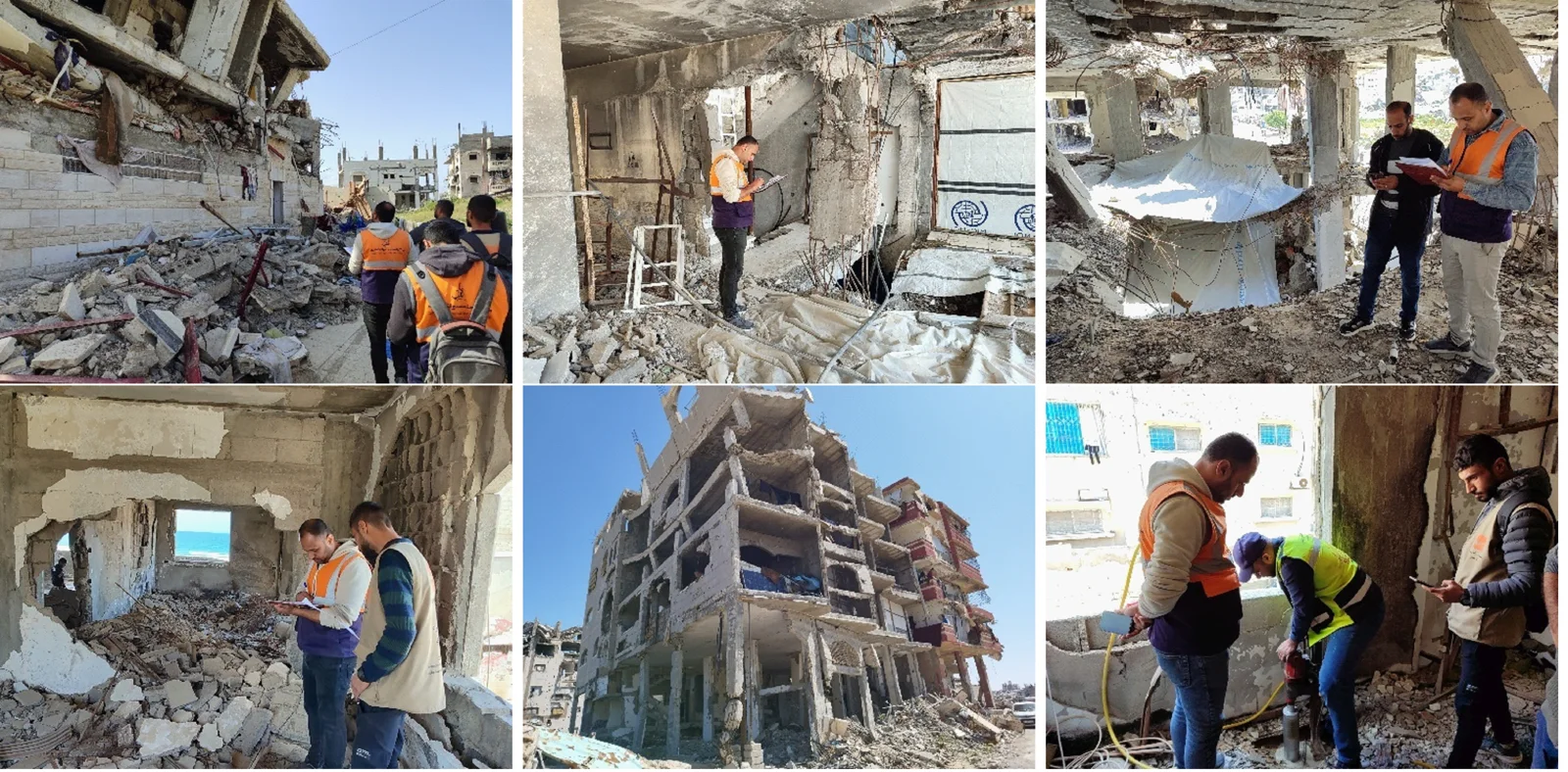
The consultancy services encompassed the development and application of a standardized RBSA methodology tailored to the Gaza context, integrating rapid visual screening, detailed structural assessments, and risk classification frameworks. CEP’s multidisciplinary teams conducted extensive field inspections of residential and public buildings, documenting various forms of damage including structural cracking, partial collapses, foundation distress, fire impacts, and material degradation resulting from prolonged exposure and conflict-related events.
A key component of the assignment involved the systematic classification of buildings based on risk levels and usability status, using defined structural indicators and performance criteria. This enabled the identification of buildings that were safe for occupancy, require minor to moderate repairs, or necessitated urgent structural intervention or demolition. The assessment approach incorporated both qualitative engineering judgment and quantitative evaluation where feasible, ensuring reliability despite access and data limitations.
To support decision-making and prioritization, CEP developed a comprehensive database and GIS-enabled platform to record, manage, and visualize assessment results. This facilitated spatial analysis of damage patterns and risk distribution, allowing NRC to optimize intervention planning and resource allocation across targeted areas.
Building on the assessment findings, CEP provided clear, actionable recommendations for each assessed structure, including conceptual rehabilitation measures, stabilization approaches, and safety precautions. The outputs of the assignment included detailed assessment reports, risk categorization matrices, and prioritized intervention lists, forming a robust technical basis for subsequent design, tendering, and implementation phases.